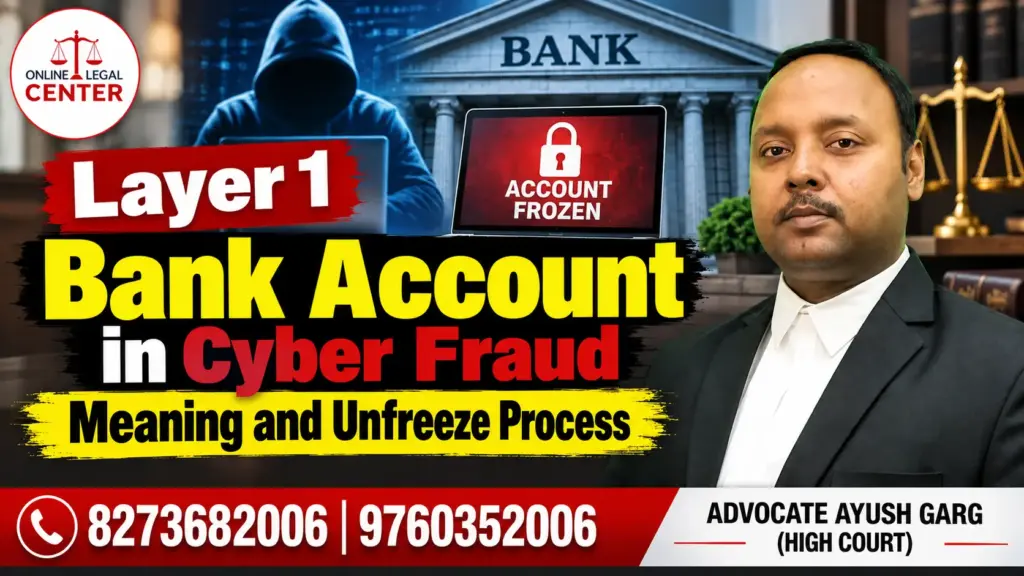
A Layer 1 bank account in cyber fraud generally refers to an account that appears directly in the transaction trail of suspected fraudulent funds. If money reported as cyber-fraud proceeds is transferred into an account, investigators may examine that account as part of the financial trail. Being identified as a Layer 1 account does not by itself establish that the account holder committed fraud.
In 2026, Indian courts have increasingly examined how cyber-fraud account freezes should be handled, particularly where a relatively small disputed transaction results in restrictions over an account containing substantially larger legitimate funds. Recent Rajasthan High Court decisions have discussed Layer 1 accounts, transaction-specific liens and proportionality in account-freezing actions.
What Is a Layer 1 Bank Account in Cyber Fraud?
In a typical cyber-fraud money trail, stolen or disputed funds may move through multiple bank accounts.
A simplified example can look like this:
Victim → Fraudster → Layer 1 Account → Layer 2 Account → Layer 3 Account → Final Recipient
The terminology can vary between investigations, agencies and banking systems. In general, the account receiving the suspected proceeds directly from the originating fraudulent transaction may be described as a Layer 1 account.
For example, suppose a cybercrime victim loses ₹50,000. The alleged fraudster transfers the money to another person’s bank account. Investigators tracing the transaction may identify that receiving account as a Layer 1 account.
The account holder may, however, have received the money without knowing that it was connected to fraud. The investigation therefore needs to examine the actual transaction, circumstances and available evidence.
Does Being a Layer 1 Account Mean You Are a Cyber Criminal?
No.
Being described as a Layer 1 account does not by itself prove criminal liability.
An account may appear in a cyber-fraud transaction trail for different reasons. For example, someone may have received a legitimate payment that was later disputed, sold goods to another person, provided a service, received a refund, or unknowingly received money originating from an unlawful transaction.
The Rajasthan High Court’s August 20, 2026 judgment specifically observed that expressions such as “suspicious transaction,” “mule account,” “Layer-1 account” or “cyber fraud transaction” cannot, by themselves, constitute adequate reasons for indefinitely immobilising an entire bank account. The court stated that such descriptions may justify investigation but cannot substitute for material connecting the account or transaction to the suspected offence.
Therefore, the important issue is not simply whether an account has been labelled “Layer 1.” The relevant questions include which transaction is disputed, what amount is involved, why the account is connected to the investigation and what evidence exists regarding the transaction.
How Does a Bank Account Become a Layer 1 Account?
A bank account may become relevant to a cyber-fraud investigation when a transaction associated with a complaint is traced to that account.
A common sequence may involve:
- A victim reports an alleged cyber financial fraud.
- The transaction details are provided to the bank or cybercrime authorities.
- Investigators trace the movement of the disputed funds.
- The first receiving account may appear in the transaction trail.
- The bank may receive a request or instruction concerning the relevant account or amount.
- A lien, hold, debit restriction or other restriction may then be placed, depending on the circumstances and applicable procedure.
- The account holder may be required to explain the transaction and provide supporting documents.
The exact procedure varies according to the facts and the authority involved.
Why Is a Layer 1 Bank Account Frozen?
A Layer 1 account may be restricted because investigators are attempting to preserve suspected proceeds of cyber fraud and prevent their further movement.
Cyber-fraud investigations can involve rapidly transferred funds moving through several accounts. Courts have recognised the investigative need to preserve suspected proceeds while also considering the effect of account restrictions on people whose accounts appear in the transaction trail.
Possible reasons for a restriction include:
- A disputed amount was credited to the account.
- The account appears in a reported cyber-fraud transaction.
- The account is identified during a money-trail investigation.
- The investigating agency asks the bank to preserve funds.
- The bank identifies suspicious activity under its applicable fraud-risk procedures.
- The account is being examined as a possible mule account.
- A cybercrime complaint has resulted in an investigation involving the account.
A freeze does not automatically determine the final liability of the account holder.
Also Read: Layer 1 Bank Account in Cyber Fraud Meaning and Unfreeze Process
Layer 1 Account Freeze vs Bank Account Lien
These terms should not automatically be treated as identical.
A lien may restrict a specified amount associated with a disputed transaction.
A debit freeze may prevent outgoing transactions.
A complete account freeze can prevent normal operation of the account more broadly.
The distinction is important because recent court decisions have considered whether the entire account needs to remain inaccessible when only a particular amount is disputed.
For example, in February 2026, the Punjab and Haryana High Court dealt with an account connected with a UPI-fraud complaint and directed that the disputed ₹1,000 remain under lien while the remaining balance could be used, subject to any other lawful order.
Similarly, in June 2026, the Allahabad High Court directed that only the disputed amount be lien-marked and that the account remain operational for normal use, while preserving the investigating agency’s ability to act according to law if further suspicious entries were found.
These decisions illustrate why the exact amount and transaction connected with the investigation can be important.
Can the Entire Bank Account Be Frozen for a Small Transaction?
The answer depends on the legal basis and facts of the particular case.
Recent Rajasthan High Court decisions have specifically examined situations where small disputed amounts were followed by restrictions over accounts containing much larger balances.
In its August 20, 2026 judgment, the Rajasthan High Court gave an example in which a suspected cyber-fraud amount of ₹500 was held against an account containing ₹5 lakh, observing that the investigative objective would ordinarily be achieved by preserving the disputed amount rather than depriving the account holder of the remaining funds.
The same judgment emphasised the distinction between holding a disputed amount and freezing the entire account.
This does not mean that every complete freeze is automatically unlawful. The legal basis, investigation, statutory procedure and circumstances of the account must be examined individually.
What Should You Do If Your Account Is Identified as Layer 1?
Do not ignore the restriction.
Start by obtaining written information from your bank.
Ask the bank for available details concerning:
- The reason for the restriction.
- Whether the account is lien-marked, debit-frozen or fully restricted.
- The disputed transaction.
- The disputed amount.
- Transaction date.
- UTR/UPI reference number, where applicable.
- Complaint or reference number, where available.
- Name of the investigating agency, where disclosure is permitted.
- Details of the communication received by the bank.
- Procedure for submitting a representation.
The information supplied by the bank may be limited where disclosure could affect an investigation. Nevertheless, obtaining whatever information can lawfully be provided is important for preparing a response.
Collect Evidence Showing the Transaction Was Genuine
If you believe the transaction was legitimate, collect evidence before approaching the investigating authority or seeking legal remedies.
Useful documents may include:
- Bank statements.
- UPI transaction records.
- UTR or transaction reference.
- Invoices.
- Bills.
- Purchase orders.
- Sale agreements.
- Service agreements.
- Delivery records.
- Payment receipts.
- GST records, where applicable.
- Salary records.
- Loan documents.
- Refund records.
- Emails.
- WhatsApp or other transaction-related communications.
- Proof explaining why the money was received.
- Proof showing what happened to the money after receipt.
The objective is to establish the legitimate commercial or personal context of the transaction.
What If You Received Money From an Unknown Person?
This situation requires particular care.
Suppose ₹20,000 suddenly appears in your account from an unfamiliar UPI ID. Later, your account is restricted because the sender has reported a cybercrime.
Do not simply send the money to another account because the sender contacts you and asks for a refund.
Instead:
- Preserve the original transaction details.
- Inform your bank.
- Keep screenshots and account statements.
- Avoid deleting communications.
- Ask the bank for the appropriate process.
- If an investigation is involved, respond through the appropriate authority.
- Obtain legal advice where the restriction is continuing or the circumstances are disputed.
Moving potentially disputed funds can complicate the transaction trail.
How to Remove a Layer 1 Bank Account Freeze
There is no single automatic procedure that removes every Layer 1 restriction.
The process generally begins with identifying the authority and reason behind the restriction.
Step 1: Contact the Bank
Request written information about the restriction and the transaction involved.
Step 2: Identify the Investigating Authority
Determine which cybercrime police station, investigating officer or other authority has requested the restriction, where that information is available.
Step 3: Prepare a Representation
Explain the transaction clearly.
The representation should include:
- Account details.
- Transaction reference.
- Amount.
- Date.
- Source of funds.
- Purpose of payment.
- Supporting documents.
- Explanation of why the account holder is not connected with the alleged fraud, if applicable.
- Request for review of the restriction.
Step 4: Submit Supporting Evidence
Attach documents that establish the legitimate purpose and source of the disputed transaction.
Step 5: Request Appropriate Relief
Depending on the facts, the request may concern removal of the freeze, reduction of the restriction to the disputed amount, removal of an incorrect lien, or another legally appropriate form of relief.
Step 6: Follow the Applicable Grievance Procedure
Recent Rajasthan High Court decisions have referred to the Standard Operating Procedure dated January 2, 2026 and the grievance mechanisms available to affected account holders. One August 2026 decision also emphasised that affected persons should initially use the applicable administrative and statutory remedies before seeking extraordinary writ relief in appropriate cases.
Step 7: Consider Court Remedies Where Appropriate
If administrative and investigative remedies do not resolve the issue, a lawyer can examine whether proceedings before the appropriate criminal court or High Court are legally available.
The correct forum depends on the nature of the freeze, the originating authority, the applicable statutory provision and the procedural history.
What Documents Are Required to Unfreeze a Layer 1 Account?
There is no universal document list for every case.
However, you should generally keep:
Bank documents
- Recent bank statement.
- Account details.
- Freeze/lien communication.
- Bank correspondence.
Transaction documents
- UPI transaction details.
- UTR/reference number.
- Transaction screenshots.
- Sender/recipient details.
- Payment confirmation.
Source-of-funds documents
- Invoice.
- Agreement.
- Salary proof.
- Business records.
- Sale/purchase documents.
- Refund evidence.
Investigation documents
- Cybercrime complaint details.
- FIR, if available.
- Police notice.
- Investigating officer communication.
- NOC or clarification, if issued.
The documents required will depend on the facts of the case.
How Long Does a Layer 1 Bank Account Freeze Last?
There is no universal period that applies to every Layer 1 account.
The duration may depend on:
- The amount under investigation.
- The complexity of the money trail.
- The investigating agency.
- The status of the cybercrime complaint.
- Whether the transaction has been verified.
- Whether a representation has been submitted.
- Whether judicial proceedings are involved.
- Whether the legal basis for continuing the restriction remains.
The Rajasthan High Court has stressed that a restriction should not continue mechanically after the investigative necessity has ceased and that banks and authorities should have mechanisms for periodic review.
Can a Genuine Account Holder Be a Layer 1 Account?
Yes, an account can appear in a transaction trail without the account holder necessarily knowing that the money was connected to fraud.
For example, a genuine seller could receive payment from a customer. If the customer’s funds were themselves connected with a cybercrime, the seller’s account could subsequently become part of the investigation.
This is why transaction records and evidence explaining the commercial or personal purpose of a payment can be important.
The investigation may need to distinguish between the appearance of an account in a transaction chain and evidence establishing intentional participation in a fraud.
Layer 1 Account and Mule Account: Are They the Same?
Not necessarily.
A Layer 1 account describes the position of an account in a particular transaction trail.
A mule account generally refers to an account used to receive, transfer or move funds on behalf of others in circumstances associated with financial crime.
An account may be described using both terms in an investigation, but the terms should not automatically be treated as proof of criminal conduct.
The Rajasthan High Court specifically grouped “mule account” and “Layer-1 account” among labels that may indicate a basis for investigation but stated that the label itself cannot replace the material connecting the account or transaction with the suspected offence.
What If the Disputed Amount Is Only a Small Part of Your Balance?
This is an important issue in current bank-freeze litigation.
Suppose:
- Total account balance: ₹4,00,000
- Alleged disputed amount: ₹2,000
The question may arise whether preserving ₹2,000 is sufficient to protect the subject matter of the investigation rather than restricting the entire ₹4,00,000.
Recent Indian court decisions have considered this distinction in cyber-fraud account-freeze matters. In one February 2026 case, the Punjab and Haryana High Court directed that ₹1,000 remain under lien while the remaining balance could be used.
The exact relief available in another case will depend on its facts and applicable law.
When Should You Consult a Lawyer?
Legal assistance may be appropriate when:
- Your account has been identified as Layer 1.
- A cybercrime complaint has caused a bank freeze.
- The bank has not provided sufficient information.
- You believe the transaction was legitimate.
- The disputed amount is small but the entire account is restricted.
- Your salary or business funds are inaccessible.
- The investigating authority has not responded to your representation.
- The account has remained restricted for a prolonged period.
- You have received a police or cybercrime notice.
- You need assistance preparing a representation or examining possible court remedies.
A lawyer can review the bank communication, transaction trail, complaint details and supporting documents before advising on the appropriate course.
Advocate Ayush Garg and Online Legal Center
For individuals dealing with a Layer 1 bank account in cyber fraud, cybercrime-related account freeze, bank lien, debit freeze or account-unfreeze issue, legal assistance can involve reviewing the transaction trail, preparing representations and examining the remedies available under the circumstances.
Advocate Ayush Garg, associated with Online Legal Center, provides legal assistance relating to matters involving bank account freezes, cybercrime complaints and related financial disputes. If you are searching for a lawyer for a bank account freeze matter, you can contact the office to discuss the facts and available legal options.
Rather than relying on a generic promise that an account will automatically be unfrozen, the appropriate legal approach should be based on the actual bank communication, disputed transaction and investigation record.
For information and assistance, visit:
Bank Account Freeze Information
Cyber Crime Complaint Information
Frequently Asked Questions
What does Layer 1 bank account mean in cyber fraud?
A Layer 1 bank account generally refers to an account that appears directly in the transaction trail involving suspected cyber-fraud proceeds. The terminology can vary between investigations.
Does Layer 1 mean the account holder committed fraud?
No. Being identified as Layer 1 does not, by itself, establish criminal liability. The underlying transaction and evidence must be examined.
Why is my Layer 1 account frozen?
An account may be restricted because investigators believe it received or handled funds connected with a reported cybercrime. The bank should be contacted to determine the specific reason and scope of the restriction.
Can only the disputed amount be frozen?
In some circumstances, courts have directed that the disputed amount remain subject to a lien while the rest of the account is made operational. The appropriate relief depends on the facts and applicable law.
Can I use the remaining money in my account?
That depends on the type and scope of restriction. If the entire account has been frozen, do not assume that you can use the balance without obtaining clarification or appropriate relief.
How can I remove a Layer 1 bank account freeze?
Start by obtaining the bank’s freeze/lien details, identifying the relevant transaction and investigating authority, submitting supporting evidence and using the applicable grievance or legal process.
Can a lawyer help remove a Layer 1 account freeze?
A lawyer can examine the transaction and investigation documents, prepare representations and advise on available remedies. No lawyer can responsibly guarantee the outcome of an investigation or court proceeding.
What if I received the money legitimately?
Collect documents establishing why you received the payment, including invoices, agreements, payment records, communications and bank statements. These documents may help explain the transaction to the bank or investigating authority.
Can a Layer 1 account be unfrozen if the cybercrime complaint is false?
A disputed or incorrect complaint does not automatically disappear from the banking system. The account holder should submit evidence and use the applicable bank, investigative and legal remedies.
Conclusion
A Layer 1 bank account in cyber fraud is generally an account that appears directly in the transaction trail of suspected fraudulent funds. However, being identified as Layer 1 is not by itself a finding that the account holder committed a cybercrime.
If your account has been frozen, the first priority should be to identify the disputed transaction, the amount involved, the authority behind the restriction and the nature of the restriction. Preserve bank statements, UPI records, invoices, agreements and other evidence showing the legitimate source and purpose of the funds.
Recent 2026 court decisions have placed significant attention on proportionality in cyber-fraud account freezes. The Rajasthan High Court has specifically discussed Layer 1 accounts and stated that labels such as “Layer-1 account” or “mule account” cannot alone justify indefinite immobilisation of an entire bank account. Other 2026 decisions have considered relief involving a lien over the disputed amount while allowing the remaining balance to remain operational.
If you are dealing with a Layer 1 bank account freeze, cybercrime lien, UPI-related freeze or bank account unfreeze matter, obtain the relevant documents first and seek case-specific legal advice where necessary.
For legal assistance and information, you can contact Advocate Ayush Garg through Online Legal Center.
Also Connect With Us
Facebook: Official Online Legal Center
Instagram: @advocateayushgarg
Twitter/X: @onlinelegalcen
WhatsApp: 9690404767
Contact Number: 8273682006
Email: info@onlinelegalcenter.com
Website: Online Legal Center